
Before September CPI: read seasonal adjustment beside the rate
A CPI story often puts monthly and annual changes side by side. They can differ in seasonal adjustment as well as period, so extracting just the numbers can distort the picture of recent inflation.
A confirmed schedule, no September result yet
The BLS calendar checked on October 8, 2026 schedules September CPI for October 14 at 8:30 a.m. US Eastern Time, or 9:30 p.m. KST that day. This article precedes the release and reports no September result.
BLS distinguishes seasonally adjusted series from unadjusted series. Removing recurring patterns, such as holidays and sales, helps analysis; it does not mean those prices were never paid.
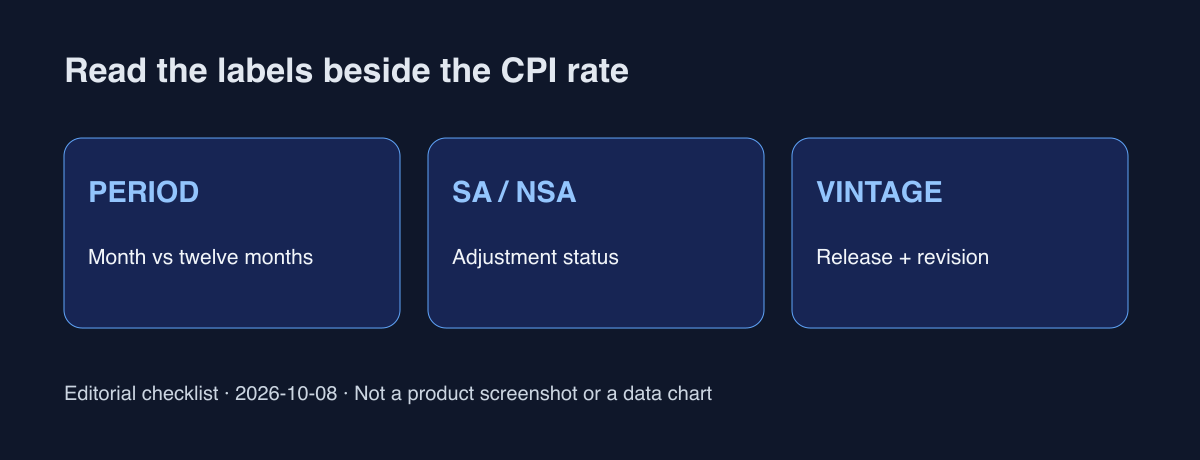
Write down the comparison period
Monthly change compares with the preceding month; annual change compares with 12 months earlier. Recent momentum and accumulated year-over-year change answer different questions. Do not subtract the two rates as an acceleration measure.
Read table headings and footnotes for SA or NSA: seasonally adjusted or not seasonally adjusted. Compare figures with the same period and adjustment basis to avoid mixing statistical objects.
Store conditions with dashboard values
Suggested fields are series, comparison period, SA/NSA, reference month and release date. Values alone make it hard to detect a switch of series next month. This is an operational suggestion, not a BLS system requirement.
Keep one consistent series in a monthly-trend chart. If annual changes have their own chart, label it as a 12-month comparison. Displaying separate questions as interchangeable measurements makes a dashboard harder to read.
Keep revised data alongside past decisions
BLS explains that new seasonal factors lead to annual revisions of the previous five years of seasonally adjusted indexes. A series downloaded later therefore need not match the file available on decision day.
Retain both the original and latest files, with a note on changes. That helps distinguish a mistaken plan from revised inputs. Do not extend this seasonal-adjustment revision rule indiscriminately to unadjusted series.
The limit of connecting CPI to invoices
Seasonal adjustment helps read short-term economic trends; it is not a formula for your next invoice. Calculate server charges, rent and foreign-currency payments separately from contracts, currency, quantities and renewal dates.
Before changing a cost budget after the release, examine direct quotations for those costs. Applying one monthly CPI rate to every supplier is not the recommendation here. The gap between national statistics and company costs limits interpretation.
A release-day sequence
Read the period and SA/NSA in the source table, compare the same stored series, and mark any data-vintage change. Then check direct company-cost evidence. Do not mix unconfirmed estimates into the dashboard as observations.
Headlines invite quick rising-or-falling narratives, but this article reports no specific market reaction or expert consensus. Define which number moved before using it to explain the team's next decision.
Official sources
For information, not investment advice. Release schedules can change; check the BLS source again on October 14.