
GitHub draft PR limits: define the intake policy before agents pile up work
When agents produce code faster, the review backlog can grow faster too. A draft pull request signals that review is not yet requested; it does not remove the work from the repository's workload. GitHub's latest change offers a concrete reason to examine that intake boundary.
What changed on October 8
On October 8, 2026, GitHub announced that pull request limits can be configured to include drafts. Previously, drafts were excluded from a user's limit, allowing additional drafts even when ordinary pull requests were limited. This is a configurable capability, not evidence that every repository's settings have automatically changed.
The announcement targets clutter, notifications and CI runs associated with low-quality contributions and repository spam. It does not prescribe one universally suitable limit. Operators should inspect the actual repository configuration and its scope before deciding what their team needs.
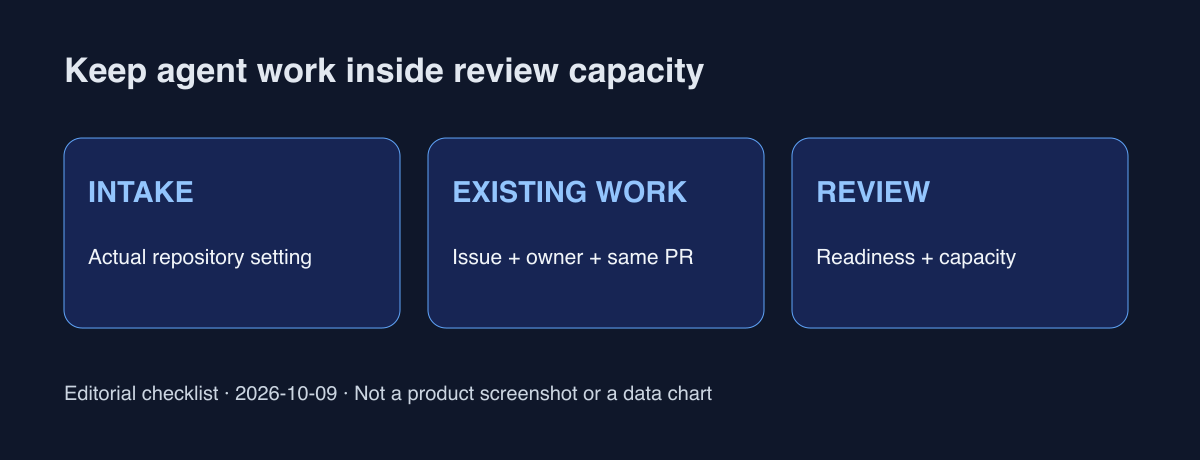
Separate draft status from capacity
Draft status communicates readiness; a limit controls incoming work. Being unfinished does not make maintenance capacity free. Conversely, it would be wrong to assume every draft runs expensive CI. Inspect actual workflow triggers and run history to determine which resources drafts consume in your repository.
Suppose an agent opens three drafts exploring alternatives for one issue. That can make comparison convenient, but it also leaves three branches and diffs to maintain. It represents three experiments rather than three committed releases. Where practical, compare alternatives in an issue or work log, then open the implementation that has a clear reviewable purpose.
Observe three things first
Before changing settings, record open draft and ordinary PR counts, each draft's owner and objective, and its last meaningful update. Then examine associated CI activity, review delays and duplicate issues. A vague impression of too many notifications is a poor basis for a limit: valid contributors may be blocked while the underlying process remains unchanged.
Agent workflows should link the repository, issue and existing PR. If creation fails, avoid a loop that immediately opens another PR under a different name. Check whether the work already has a PR and update that one. This is an operational design proposal for your team, not a new automatic behavior promised by GitHub.
Explain the blocked path
Guidance for a contributor who reaches a limit should explain how to continue existing work, what review-ready means and who can help. Do not present conversion from draft to ordinary PR as a way around the policy. Before closing or archiving work, inspect its owner and useful content; a cleanup count is not a substitute for judgment.
Teams using several dependent PRs should not treat draft count alone as a quality score. A sequence of small diffs differs from repeated submissions of the same change. The limit protects intake; it does not replace review criteria, tests or deployment decisions. Document the legitimate workflow alongside the restriction.
Start small and compare outcomes
Apply a documented policy and exception path to one repository, verifying the actual settings. Compare draft growth, reuse of existing PRs, review waiting time and cases where valid contributors were blocked over the same observation period. Fewer open items alone does not establish higher quality; check whether useful work was merely delayed or moved elsewhere.
The useful action today is to make the same task return to the same PR before increasing agent frequency. GitHub's announcement links a community feedback channel for configuration experience. No unverified user reactions or measured improvements are presented here. Use your own baseline to evaluate whether the change solves your repository's real constraint.
Official source
Checked October 9, 2026. Distinguish the announced product capability from the operational proposals in this article.