
Before September US PPI: separate producer selling prices from your team's invoice
If producer prices rise, will your next supplier invoice rise by the same amount? To turn an economic release into a cost plan, start with where the transaction sits rather than the headline rate. US PPI measures producer selling prices; that is not automatically the amount your team pays.
The schedule and the unknown result
As checked on October 9, 2026, BLS schedules September PPI for October 15 at 8:30 a.m. Eastern Time, or 21:30 KST. This is a guide written before the release. It does not claim a September result or anticipate a verified market reaction.
BLS describes PPI as a family of indexes tracking changes in selling prices received by domestic US producers of goods and services. CPI looks from the buyer's perspective. A producer-stage signal can be useful without directly reporting your customer's subscription payment or an importer's complete procurement bill.
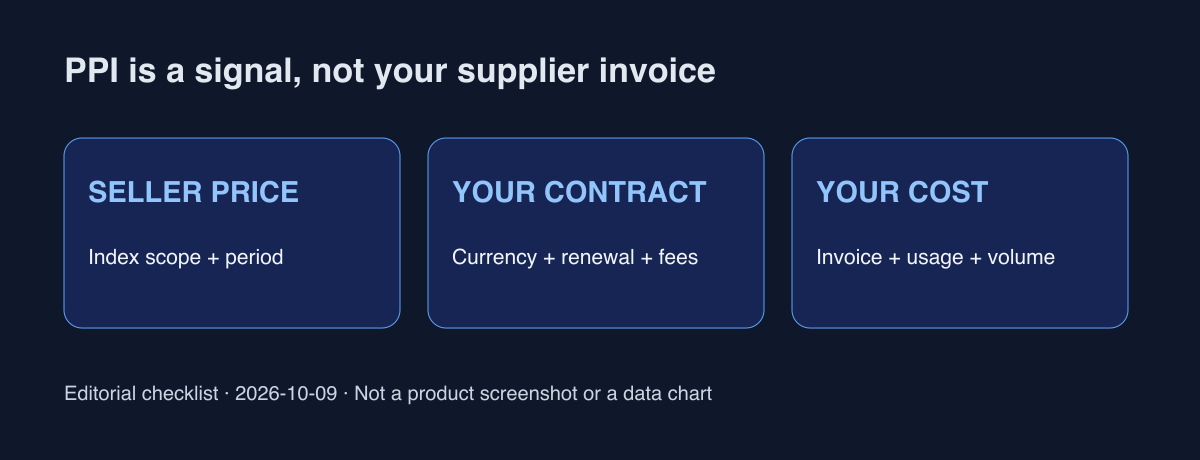
The steps between an index and a contract
Separate aggregate final demand from goods and services components when reading the release. Even a relevant category does not represent your supplier's exact contract. Check the index's comparison period and adjustment status, then separately inspect the renewal date, currency and price schedule in your agreement.
Consider a hypothetical software team billed in dollars. Its total may change because of usage or conversion into local currency while the price schedule remains unchanged. Conversely, an index increase may leave a fixed-price contract's immediate bill untouched. This is an operating example, not a claim about any vendor's announced price change.
Take care with trade-service figures
BLS notes that trade indexes measure changes in margins received by wholesalers and retailers. A movement in that category should therefore not be read as the identical change in a product's shelf price. Read the item label and its footnotes together before using a number in a cost discussion.
Markets sometimes interpret producer prices as an early signal for consumer inflation. But the timing and scale of an individual vendor's pass-through depend on contracts, demand, competition and inventories. This article proposes examining those channels; it does not establish a causal forecast for next month's CPI or your supplier's next quote.
Three separate notes for a small team
In the release note, record the series, reference month, comparison period and publication date. In the contract note, record currency, renewal, unit price and notices of change. In the invoice note, record usage, quantity, fees and exchange rate. Keeping these records separate prevents an economic headline from being mistaken for evidence of your actual cost increase.
If spending rises, compare invoices on the same scope first. Separate more services or greater usage from a higher unit price. Then attach relevant indexes and supplier communications as supporting context. Avoid applying one headline index mechanically to every budget line: the mix of costs and the terms behind each line can differ substantially.
After release, revise the checks
When official results arrive, update the assumption log and inspect relevant components and revisions. If the next invoice has not arrived, label its cost impact as awaiting confirmation rather than moving it into confirmed spending. Before renewal, obtain the supplier's actual notice and pricing terms.
Re-reading every contract after every release also consumes time. Prioritize material spending and approaching renewals. The three-note method is an operational suggestion for small teams, not an official BLS budgeting product. Its value is making the basis of a decision inspectable, not producing a precise forecast from incomplete information.
Next week's PPI is most useful when you first ask whose price it measures and for which transaction. Use it to narrow the evidence you need, rather than treating its headline as your invoice. Investment and pricing decisions still require the relevant contracts, customer conditions and your own cost records.
Official sources
For information only, not financial or investment advice. Facts and operational interpretation are distinguished as of October 9, 2026.