
US employment projected to grow 3.5%: separating net growth from hiring opportunities
A projection of 3.5% employment growth over ten years can make the hiring market sound equally quiet. But a net increase in employment and the need for people to enter occupations are different quantities.
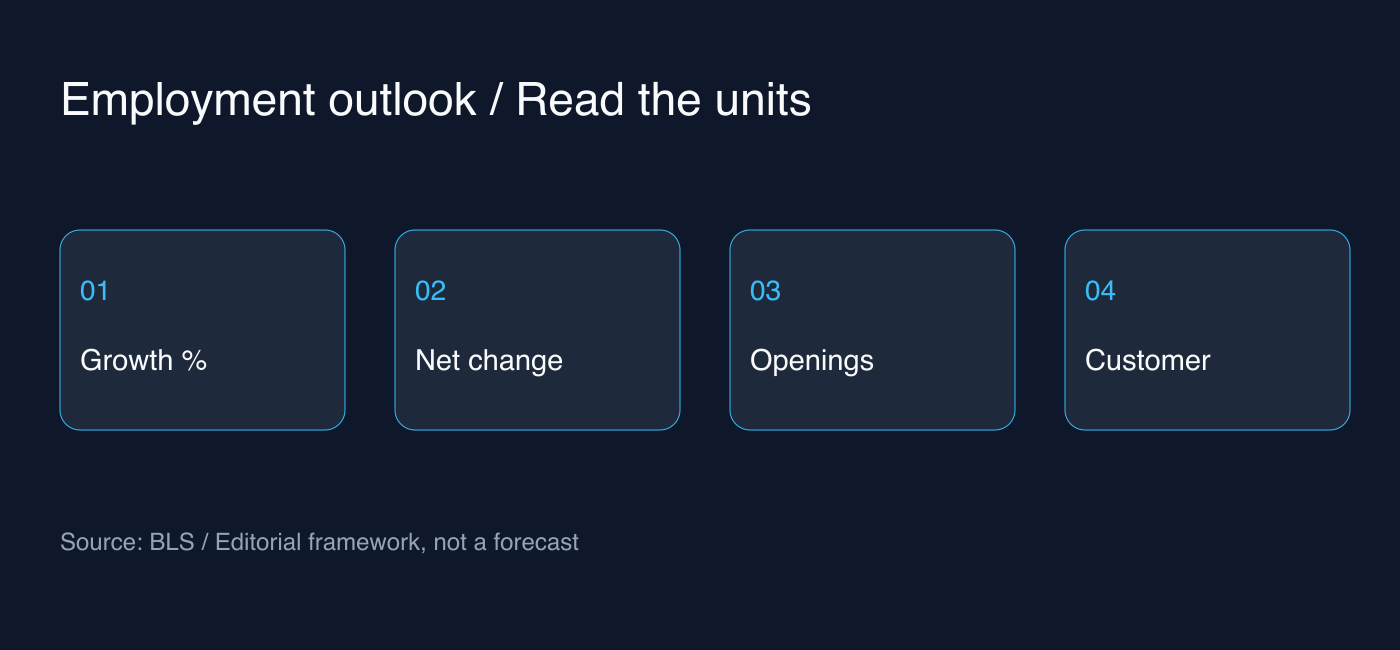
On August 27, 2026, BLS released its US employment projections for 2025–2035. Rather than recommend a list of promising careers, this article helps founders and practitioners separate the denominators in the tables.
What the projection actually covers
Total employment is projected to grow 3.5% between 2025 and 2035, adding approximately 5,917,600 jobs. That is a cumulative ten-year projection, not an annual growth rate or an already observed outcome.
These are long-term projections released on August 27, not a new monthly employment result. Before comparing figures, confirm that they share the same projection period and occupational classification.
Fast growth versus a large market
Among major groups, healthcare support occupations are projected to grow 13.3%, while computer and mathematical occupations grow 7.3%. Neither number is a forecast for a particular company's revenue or your product's customer base.
A small group expanding quickly and a large group growing slowly can require very different numbers of people. Read percentage growth alongside employment added and the starting employment level, rather than treating the percentage ranking as a market-size ranking.
Net additions and annual openings
The occupational table separates ten-year employment change from average annual occupational openings. Converting its thousands unit, annual openings across all occupations total about 17,461,800. That is not the same quantity as the ten-year net increase.
BLS combines employment change with separations caused by leaving the labor force and moving to a different occupation. Even a shrinking or flat occupation can therefore offer entry opportunities. This projection is not a count of job advertisements available today.
AI is not a universal answer
BLS explains that digital tools and AI can support demand in some occupations while automation reduces demand in others. The same technology does not necessarily push every occupation in the same direction.
The table does not establish that AI eliminates all hiring or that every AI-related service will grow. We do not present selected community reactions as representative opinion; our interpretation is that product demand still requires separate evidence about customers' work and budgets.
Ask about tasks, not just job titles
The following is an operating suggestion, not an official forecast. Alongside an occupation's projected growth, ask prospective customers about repetitive tasks, handovers and how new employees learn the work.
For example, frequent personnel movement may create training and documentation needs even without much net employment growth. Whether those needs produce paid software purchases is another question: identify decision makers, budget cycles and existing alternatives.
A ten-year outlook is not next quarter's plan
Do not multiply a ten-year forecast directly into next quarter's revenue target. It provides structural context, but cannot explain every short-term hiring freeze, local condition or route to market for your team.
Use customer interviews and trials to identify recurring problems, then design a bounded product experiment. Choose observable success measures such as time spent on the task, repeated use and willingness to pay, instead of relying on broad industry growth.
Three notes to keep beside the table
Write down the period, unit and concept next to each figure. Label ten-year percentage growth, ten-year added employment and annual openings separately so differently sized quantities do not become one misleading league table.
US occupational projections also cannot be transferred unchanged to a particular Korean region or a company's staffing plan. Use them to narrow the questions worth exploring, then support hiring and product decisions with evidence from the actual market.
This article provides information for understanding economic data, not investment advice. It guarantees neither employment in a particular occupation nor returns on any asset.