
GitHub Actions Ubuntu 26.04 Migration: Isolating Runner Differences on the Same Commit
CI results can change even when no source code has been altered. If your workflow relies on ubuntu-latest for its execution environment, operating system image transitions must be treated as changes your team actively manages.
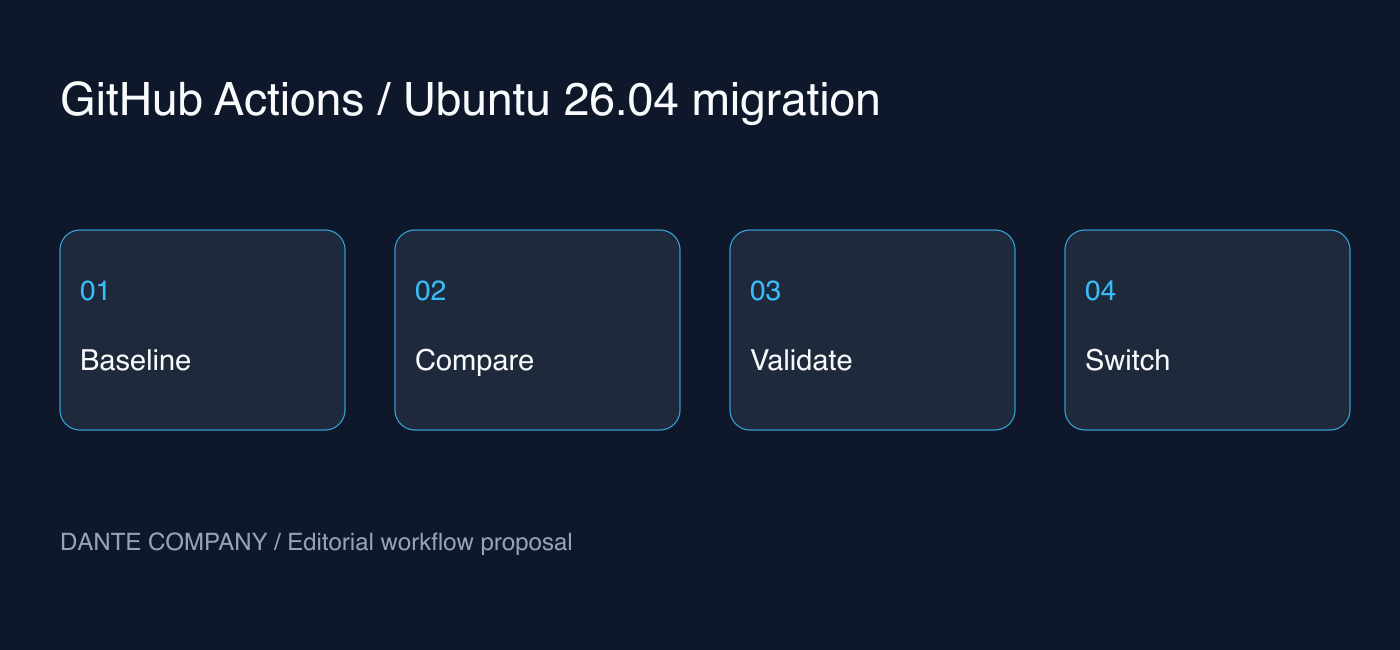
GitHub announced official support for Ubuntu 26.04 runners and its transition timeline for ubuntu-latest on September 17, 2026. Rather than claiming the new image is inherently faster, this article offers practical recommendations for isolating and verifying environment differences using the same commit.
Scope Confirmed in the Official Announcement
According to the announcement, the Ubuntu 26.04 image is officially supported on x64 and arm64, with explicit labels ubuntu-26.04 and ubuntu-26.04-arm. The ubuntu-latest label is scheduled to gradually transition from Ubuntu 24.04 to 26.04 between October 19 and November 19, 2026.
The new image includes updated or removed tools, which may affect builds relying on pre-installed packages. If you are not yet prepared, GitHub advises explicitly specifying ubuntu-24.04. Note that this schedule does not necessarily reflect the exact date every individual repository will transition.
Documenting the Environment Your Repository Expects
Start by checking runs-on in your workflows and reusable workflows. Do not assume host effects disappear simply because you use containers; it is advisable to inspect steps executing outside containers as well, such as installation, compression, and artifact uploads.
Try categorizing your checklist into compilers, runtimes, package managers, and system libraries. Instead of merely listing tool names, linking where they are installed and which steps invoke them makes it much easier to pinpoint the root causes of failure logs.
Same Commit, Two Environments, Independent Artifacts
Migration rehearsals are clearest when initiated on test paths without deployment privileges. Run the exact same commit and lockfile across both existing and new images, preserving logs, test results, and artifact names separately. This is the verification approach suggested in this article.
In initial comparisons, document cache conditions so you can distinguish the effects of stale caches. Beyond build success or failure, record installed tool versions, failed steps, and artifact execution outcomes to identify builds that passed merely by chance due to cache hits.
Verification Beyond the Green Checkmark
For web projects, verify whether generated files can actually be served; for native dependencies, ensure they load properly in the target environment. Rather than requiring every artifact to be byte-identical, distinguish non-deterministic differences like timestamps from actual functional disparities.
Reviewers should be able to see the run link for the new image, tool version differences, key functional test results, and rollback steps in one place. Mixing application refactoring into a runner migration unnecessarily broadens failure causes and rollback scope.
Benefits and Lingering Limitations of Pinning Images
Explicit OS labels help manage major transitions, but they do not guarantee a completely immutable build environment. Maintain the habit of explicitly installing necessary execution tools and logging their actual versions.
Small repositories do not need an elaborate new verification infrastructure. You can start simply by comparing a single representative build and the most sensitive dependencies, and if you implement a temporary pin, assign an owner and a re-evaluation date to unpin it.
Separating Public Discussions from Your Team's Decisions
The public runner-images issues repository is a channel for tracking image changes and reported problems. However, specific comments or failures in other projects do not necessarily mean they will reproduce in your repository, and this article makes no numerical claims regarding community consensus or failure frequencies.
Your task today is to identify where latest labels are used and test the same commit on the new image. Defining pass criteria and deferral conditions beforehand ensures your team can evaluate changes using consistent evidence, even if builds shift during the actual transition period.