
How to Read the September FOMC: Rate Decisions, Projections, and the Press Conference Are Distinct Information
Immediately after the FOMC meeting, the single line that spreads fastest is whether interest rates were raised or cut. However, for small teams that pay cloud costs in US dollars or receive overseas revenue, reading the announcement by breaking it down into multiple layers is more useful. Without predicting the outcome, this article suggests a reading order to prepare while waiting for decisions that have not yet been released.
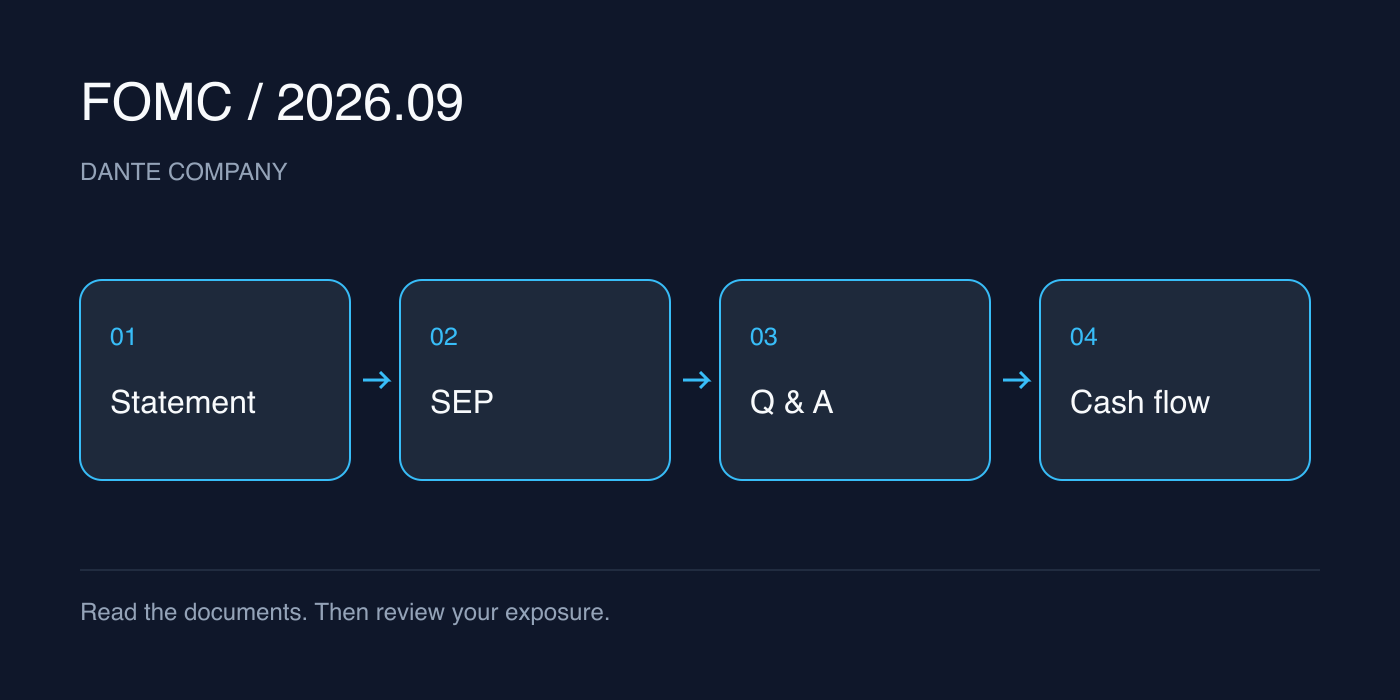
Confirmed Schedule and Yet-to-Be-Confirmed Results
According to the official Federal Reserve schedule confirmed on September 14, 2026, the next FOMC meeting takes place locally on September 15–16. The September calendar marks the meeting announcement at 2:00 PM and the press conference at 2:30 PM on the 16th. During this period, the time difference between US Eastern Daylight Time and Korean time is 13 hours, corresponding to 3:00 AM and 3:30 AM on September 17 in Korea.
The official annual meeting schedule indicates this meeting is accompanied by the Summary of Economic Projections (SEP). At the time of writing, the September statement, projection figures, and press conference answers are not confirmed outcomes. We do not conflate the release schedule with upcoming numbers to claim that a cut or freeze has been finalized.
First Document: What Was Actually Decided This Time
When the announcement is released, first check the actual policy decision in the statement. After reading directional phrasing in the headlines, examine the specific implementation details and changes in wording contained in the original text. Even if market reactions appear first, they cannot be seen as representing all the contents of the original policy text.
The operational question at this stage is simple: distinguish whether there are items directly linked to our team's current contracts or loan terms, or if it is still background information. Not every Federal Reserve announcement immediately changes next month's bill.
Second Document: Do Not Read Projections as a Fixed Path
When projection materials are released, first check the time periods and variables described by the figures. Projections are not the same kind of information as the policy decision announced today. Therefore, it is best to avoid treating the future interest rate path like a finalized contract and locking cash planning into a single number.
The suggestions below are operational interpretations, not forecasts of the numbers in the economic projections. While maintaining your team's baseline plan, try calculating separate scenarios for cases where costs rise and cases where they fall. If the actual applied exchange rate, payment date, and billing currency do not align, Korean won costs cannot be calculated solely based on the US policy direction.
Third Material: Identifying Uncertainty Through the Press Conference
In the press conference, you can hear further explanations surrounding the policy judgment through questions and answers. Rather than taking a single sentence out of context, check which question was answered and whether it reflects a current assessment or a conditional explanation. Hearing the explanation does not finalize the outcome of the next meeting.
Which phrasing the market deemed important is a separate object of observation. Since this article does not verify current pricing or rate cut probabilities, it does not present market consensus or probability figures. The recommendation is to keep interpretation of the original text and observations of market pricing as separate records.
Small Teams Find Real Exposure in Their Invoices
From an operational standpoint, you can start by listing dollar payments and receipts for the next quarter separately. By separating outgoing funds such as overseas SaaS subscriptions, cloud usage fees, and outsourcing contracts from incoming funds like overseas sales settlements, you can see which side's fluctuations affect your cash flow.
Even for the same dollar cost, the response differs depending on whether it is a fixed contract or usage-based. If it is a service where usage can be reduced, improving product efficiency can be a direct measure, and if it is an already confirmed payment, you would check whether the payment date aligns with the currency held. This does not recommend purchasing specific financial products or timing currency exchanges.
What to Change and What to Keep After the Announcement
After the announcement, try writing down the confirmed facts, our interpretation, and the internal figures to check across three columns. The actual rate decision goes into the first column, the potential impact on costs into the second, and the next billing amount and contract renewal terms into the third. When different types of information are blended into a single line, it becomes difficult to retrace the basis for judgments later on.
The counterargument that there is no need to change all plans based solely on this announcement is also valid. For teams with minimal dollar exposure and fixed payment terms, verifying the information may be sufficient. For teams with significant exposure, setting a review date with responsible staff and making adjustments when actual billing figures change is more realistic.
This article provides general information and economic interpretation and does not constitute investment advice. It does not guarantee returns on specific assets, exchange rate directions, or future Federal Reserve decisions.