
September US payrolls rose 29,000: read earlier revisions separately
Reading only the newest number in a US jobs report can miss an important second story: the path you thought you knew over the summer has changed. Put September's change beside the revisions to July and August, and label the period each number describes before drawing a business conclusion. A headline can be useful for discovery without being a complete decision record.
In its October 2, 2026 release, BLS reported a September nonfarm payroll gain of 29,000 and an unemployment rate of 4.2%. BLS described both as little changed. This article starts from those published figures and offers a way to organize the evidence. It does not establish the next interest-rate decision, the next market move, or a guaranteed outcome for your company's customers.
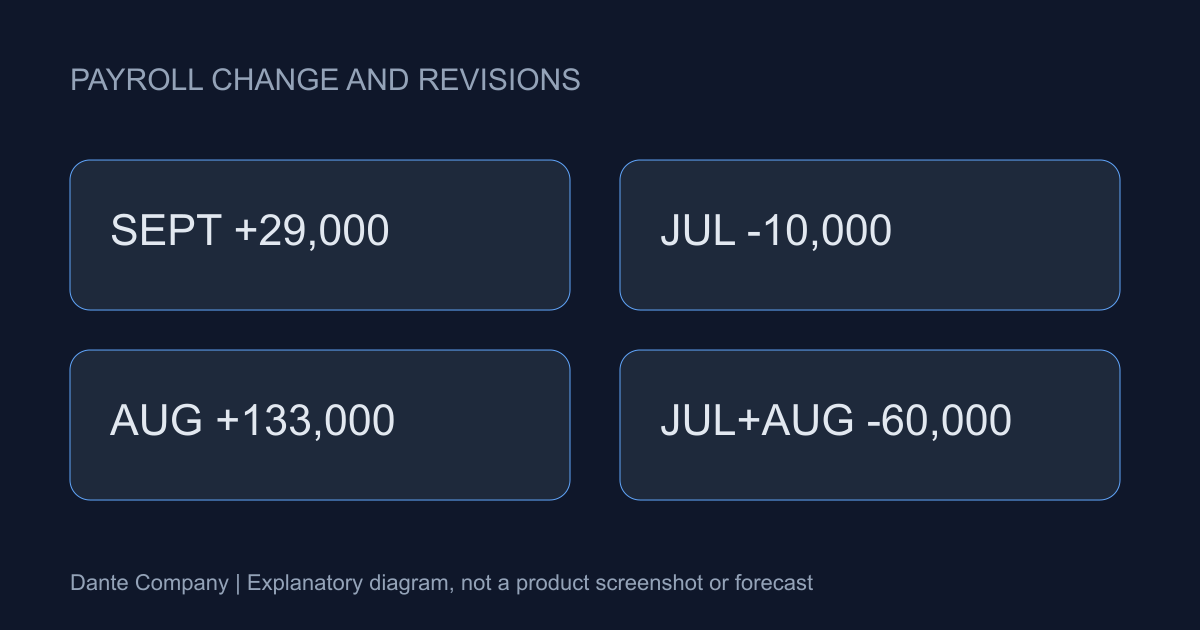
The current month's gain and earlier revisions are different quantities
July's payroll change was revised from +21,000 to -10,000, and August's from +162,000 to +133,000. Together, those two months are 60,000 below the previously reported estimates. That is a revision to earlier periods, not a statement that 60,000 jobs disappeared in September. Keep the original estimate, revised estimate, and reference month visible when comparing releases.
Subtracting the earlier 60,000 revision from September's 29,000 gain and naming the result a September net loss mixes periods. Read the current month's movement and the new information about the preceding path separately. A dashboard can show both, but it should not quietly turn a cross-period calculation into an official monthly statistic.
A revision is not a complete verdict on a forecast
BLS explains that monthly revisions reflect additional reports from businesses and government agencies and recalculation of seasonal factors. A dashboard that stores the first estimate as a final value therefore needs a way to update prior periods when another release arrives. Otherwise, a chart can preserve an obsolete history while displaying a current headline at its edge.
This is not a reason to ignore the indicator. Our operational suggestion is to record the release date and data version alongside the decision. Separate a comparison using revised data from an evaluation of what was reasonably known at the original decision date. That makes the discussion more useful than treating hindsight as proof that the earlier team should have known the later revision.
Compare the signal with your own customers
A weak hiring headline does not translate directly into weaker sales for every product or an automatic rate cut. Here we interpret it as a prompt to review demand evidence. BLS has not forecast a revenue decline for your particular small team. The path from national employment to a subscription renewal still depends on who your customers are and how their budgets work.
Compare payment conversion, renewals, sales-cycle length, and staffing plans over matching periods. If internal demand differs from the national signal, ask which customer group explains the difference. You can review the assumptions without immediately freezing hiring or changing prices. A reversible check of evidence is more informative than committing to a broad policy from one aggregate number.
Keep confirmed facts separate from the next judgment
The release establishes September's estimate and revisions to the two earlier months. The overall economic direction, policy response, and asset-price implications require additional evidence. A small gain alone does not settle a recession call, just as the existence of revisions does not invalidate every statistic. Both conclusions would extend beyond the facts reviewed here.
At the next release, check revisions to September as well as the new month. For now, revisit your plan's assumptions and the internal evidence for customer demand, while preserving the original decision record. This article provides economic information and interpretation; it is not personal investment guidance or financial advice.