
October Beige Book: do not turn AI hiring anecdotes into a national layoff rate
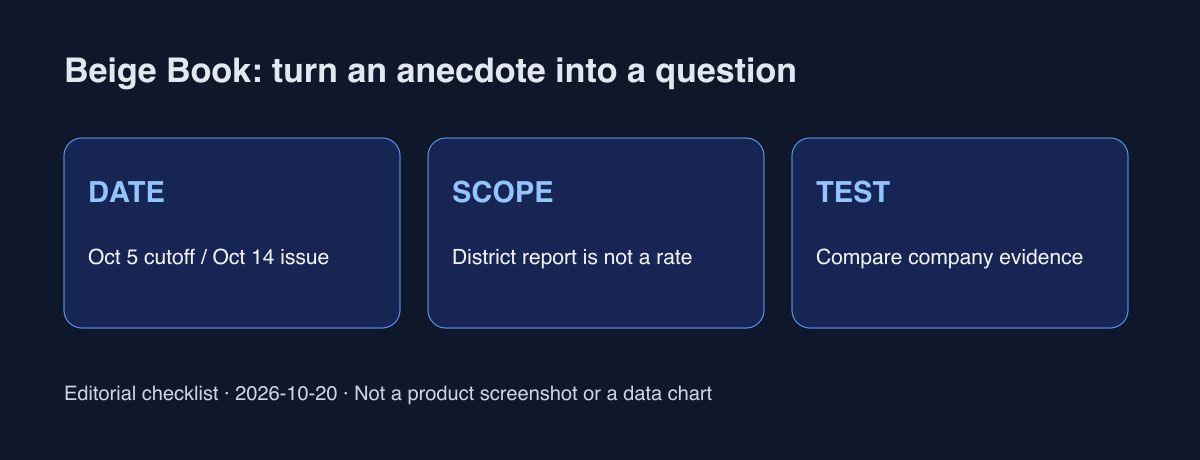
Does an account of AI-related hiring restraint mean your own team should reduce its hiring budget? The Beige Book released on October 14, 2026 is useful material for that question, but it is not a table from which to calculate a national layoff rate. This edition uses information collected on or before October 5. Record both the publication date and the observation cutoff. A recently published document does not necessarily measure conditions in real time, and a vivid business story does not supply a representative national denominator.
What the report establishes—and which denominator it does not
The national summary says five Districts reported some firms reducing staffing through attrition, delaying hiring, or anticipating less job creation after AI productivity investment. That does not mean all firms in those Districts, or five-twelfths of US workers, were affected. Counting District reports and presenting that count as a worker or business share changes the denominator. The document also says it summarizes comments from contacts outside the Federal Reserve System and does not present Federal Reserve officials’ views. Preserve those boundaries when quoting an account in a management memo.
Use qualitative evidence to choose the next question
The Fed’s FAQ describes the Beige Book as mostly qualitative information gathered from District contacts. It can surface developments that available statistics have not yet made apparent, but a sentence alone does not establish their scale or causal effect. Our proposed practice is to turn an anecdote into a testable operating question. Has the team’s backlog actually fallen, has processing become faster, or has work shifted into review and customer support? Compare workload and completed-work quality before converting a productivity claim into a headcount target.
Input costs and realized pricing need separate records
The national summary describes margin pressure among consumer-facing firms whose customers resist price increases. This is not a measured, uniform margin decline for all businesses. A suggested company-level response is to maintain separate cost and revenue records. Put supplier invoices, renewal dates, and surcharges on the cost side; realized customer prices, discounts, and volumes on the revenue side. A rise in input costs does not prove that an equivalent selling-price increase has already passed through. The timing of a contract renewal can matter to your own budget even when an aggregate narrative sounds familiar.
Require your own evidence before changing a budget
For hiring, compare current staffing, uncompleted work, rework after AI use, and service quality over matching periods. For procurement, compare renewal quotations with prices customers actually accept. These checks are the author’s operating proposal, not a Fed forecast for individual companies. Cost pressure could restrain hiring, while demand or a shortage of specialized workers could support it. Do not make one anecdote an automatic company-wide trigger. Record the decision owner, review date, and missing evidence so a provisional assumption can be revised when conditions change.
Market and community arguments about AI and jobs help identify questions readers care about. They do not make this report a forecast of the national unemployment rate, AI’s net employment effect, or the next interest-rate decision. Nor should qualitative evidence be discarded simply because it is not a statistical series. While aggregates show averages, contact reports can suggest mechanisms worth investigating. Keep the anecdote as a hypothesis and compare relevant official employment statistics and your own operating results over compatible periods. That is a more useful role for the report than treating its strongest sentence as a budget instruction.
Sources and reading notes
Federal Reserve · October national summary
Federal Reserve · Beige Book FAQ
Checked October 20, 2026. This is economic context for information, not financial advice. Bring one report claim and the internal evidence needed to test it to your next budget meeting.