
Public GitHub clones may ask for authentication: audit anonymous CI paths
A public repository can still be a hidden availability dependency when a build assumes it can always fetch code anonymously. On October 19, 2026, GitHub announced that unusual traffic may trigger temporary authentication requirements for some HTTPS clones and fetches of public repositories. That does not mean the repository became private. The practical task is to identify the affected acquisition path, establish its identity where appropriate, and prove that a fresh build can obtain its inputs. The checks below are operational suggestions, separate from the announced product behavior.
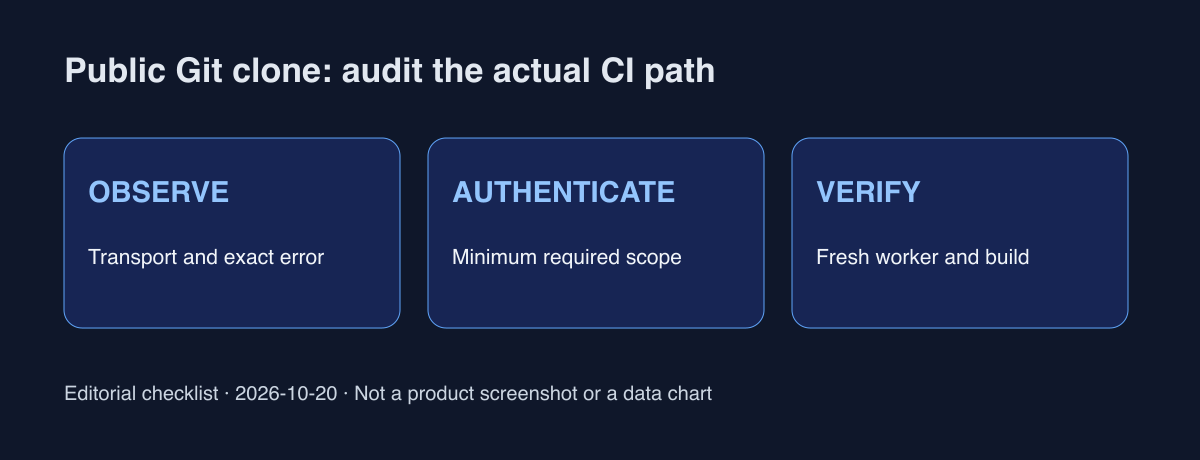
Read the boundary before declaring an outage
GitHub says this protection can apply across all github.com plans. It is not a standing authentication requirement for every public repository. Authenticated HTTPS operations, SSH operations, pushes, and unrelated web and API traffic are unaffected by this measure. Start with the actual failure message: does it say authentication is required? A failed anonymous fetch alone does not establish an API outage or a repository permission change. Preserve that distinction in incident notes so another engineer does not spend time debugging the wrong service.
Look beyond the first checkout
This inventory is a proposed team practice. List installer scripts, Docker build stages, submodules, and test-fixture downloads as well as the initial checkout. For each path, record its execution environment, target repository, transport, authentication status, and owner. A warm cache can hide a dependency that fails only on a new worker, so validate one representative job with empty caches where practical. Do not distribute credentials to paths the job never uses. The inventory should help reduce unnecessary access while identifying the acquisitions on which delivery actually depends.
Choose identity and access scope together
GitHub recommends the built-in GITHUB_TOKEN for Actions and prefers a GitHub App installation access token for other CI systems; a PAT is also an option. The workflow token is scoped to its own repository, so do not assume that it grants access to another repository. Check the target and documentation, then grant only the permissions required. Use the CI secret store and a supported authentication mechanism. Avoid copying examples that put a token into a clone URL or debug output. A successful credential setup should include an owner and a removal path, not merely a secret that remains indefinitely.
Record a useful failure and prove the recovery
Keep a redacted error message, timestamp, transport, authentication status, and retry outcome. If an authenticated operation still fails, investigate expiry, repository scope, permissions, and network conditions separately. For a job that cannot authenticate, the announcement allows retrying after the temporary protection has lifted. Set a bounded retry count and waiting limit, with an escalation owner; an infinite loop makes both completion time and diagnosis unclear. After a change, test acquisition in a fresh execution environment and run the downstream build or tests. Merely saving a token is not evidence that the dependency can be fetched.
Community questions about whether public code is being closed off are useful discovery signals, not proof of a broader policy. The announcement does not establish a causal share for AI traffic, and this article assigns none. Moving every remote to SSH is not required by the notice either. Authentication adds credential-management work, so start with one affected automation, validate the access and revocation boundaries, and expand only where needed. The decision should rest on the observed path and the resulting execution evidence rather than a blanket migration or a headline.
Official sources
GitHub Changelog · Temporary Git authentication
GitHub Docs · Workflow authentication
GitHub Docs · Authentication boundaries
Checked October 20, 2026. Start by documenting one CI job’s anonymous acquisition paths and their credential owner.