
Before US import prices: preserve first releases alongside revisions
If last month's report and today's downloaded table show different numbers for the same month, check when each was published before interpreting the difference. BLS schedules September 2026 US import and export prices for October 16 at 08:30 ET, or 21:30 in Korea. This is preparation ahead of that release, not a forecast of the September result or the market response. The practical issue is how to retain the information available when a decision was made while still using the latest information now.
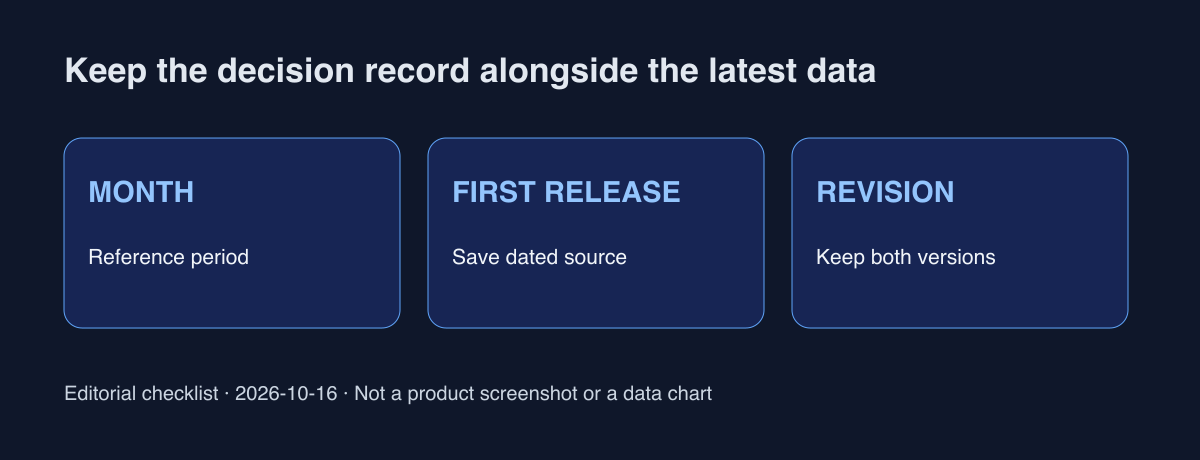
A reference month also has an information date
The BLS technical note says monthly import and export price data may be revised during the three months following their initial publication to incorporate late reports and respondent corrections. No further revisions take place after that interval. A first-release table and a later table can therefore differ for the same reference month. That difference is not the same thing as a price change in a newly observed month. Mixing the two can make a report confuse an economic development with an improvement in measurement information.
Keep an as-decided view and a current view
What follows is an operating recommendation, not an official requirement imposed by BLS. Record the reference month, release date, retrieval time, series name, monthly or annual comparison and source link in the procurement review. The archived version explains what could reasonably have been known then; the latest version describes the current evidence. Silently overwriting the old report with today's data can judge a past decision using information unavailable to its owner. Keeping only the old values creates the opposite problem: it prevents a useful update to the present assessment.
Market context and your contract have different scopes
BLS import goods prices are based on dollar prices paid by US importers. The index does not directly track every invoice of a Korean business or the terms agreed with a particular supplier. Before applying an increase or decrease to a budget, separately examine ordering dates, payment currency, quantities and the product mix. A revised index is not, by itself, grounds for recalculating an already signed contract or switching suppliers. Treat the indicator as context and connect any operational change to evidence about your actual transaction.
Separate two changes after the release
Read the movement in the new reference month first. Then check whether earlier months differ from their previous published versions. Label these as a new observation and a revision to an existing observation so the explanation remains clear. Do not assume in advance how large revisions will be or whether their direction will reverse. Record differences only when the published tables establish them. An internal note should identify the changed cells and the interpretation affected, without forcing every minor statistical adjustment into an immediate purchasing decision.
Revision risk is also not a reason to postpone every decision for three months. Inventory shortages and other time-sensitive needs may require action using the information then available. Record a condition for reassessment at the next release instead. Contracts, inventory and cash flow remain separate evidence. When comparing claims about a release, check that the series, comparison period and publication vintage match. This article asserts no unverified community reaction, consensus estimate or revision forecast.
Today, decide where release history will live beside any automatically refreshed shared table. Retain the official source with its date, and ask whether a documented difference would materially change the next procurement review. The revision window is an official statistical rule; maintaining these two views is an independent interpretation for team decision records. Keeping both makes it possible to learn from past choices without pretending that today's information was available yesterday.
Official sources
BLS · Import/export prices technical note
Checked before the October 16, 2026 release. Economic context for information only, not investment advice.