
Ahead of U.S. Import Price Release: Why the Index and Landed Purchase Costs Differ
It is easy to assume that hearing news of stabilizing import prices means the cost of your next purchase order will also remain unchanged. However, the scope of the U.S. Import Price Index differs from the actual purchase payments a company makes. Judging cash expenditures inclusive of tariffs based solely on price statistics that exclude tariffs leads to misaligned decisions.
According to the BLS schedule, the August 2026 U.S. import and export price indices are scheduled for release on September 16 at 8:30 a.m. Eastern Time (9:30 p.m. KST on the same day). This article is a pre-release commentary written on September 15 and does not present yet-to-be-released figures or market consensus forecasts.
Confirmed Fact: Tariffs Are Excluded from the Index
The BLS FAQ specifies that import duties (tariffs) are excluded from the prices used to calculate the index. Therefore, the mere fact that the index did not rise does not mean that the tariffs paid by importers are nonexistent or have decreased.
That does not mean tariffs have no bearing on the statistics. The BLS explains that suppliers may adjust prices before or after tariffs are levied. One must distinguish between the direct inclusion of the tariff itself and the channel through which companies' pricing responses are reflected in measured prices.
The Intermediate Steps Connecting the Index to a Company's Cost
The aggregate index shows price trends across a basket of multiple goods. Because this may differ from a specific company's purchasing mix, it is necessary to check categories closely aligned with your own business. While the BLS provides detailed product classifications and some international service indices, these do not substitute for an individual company's invoices.
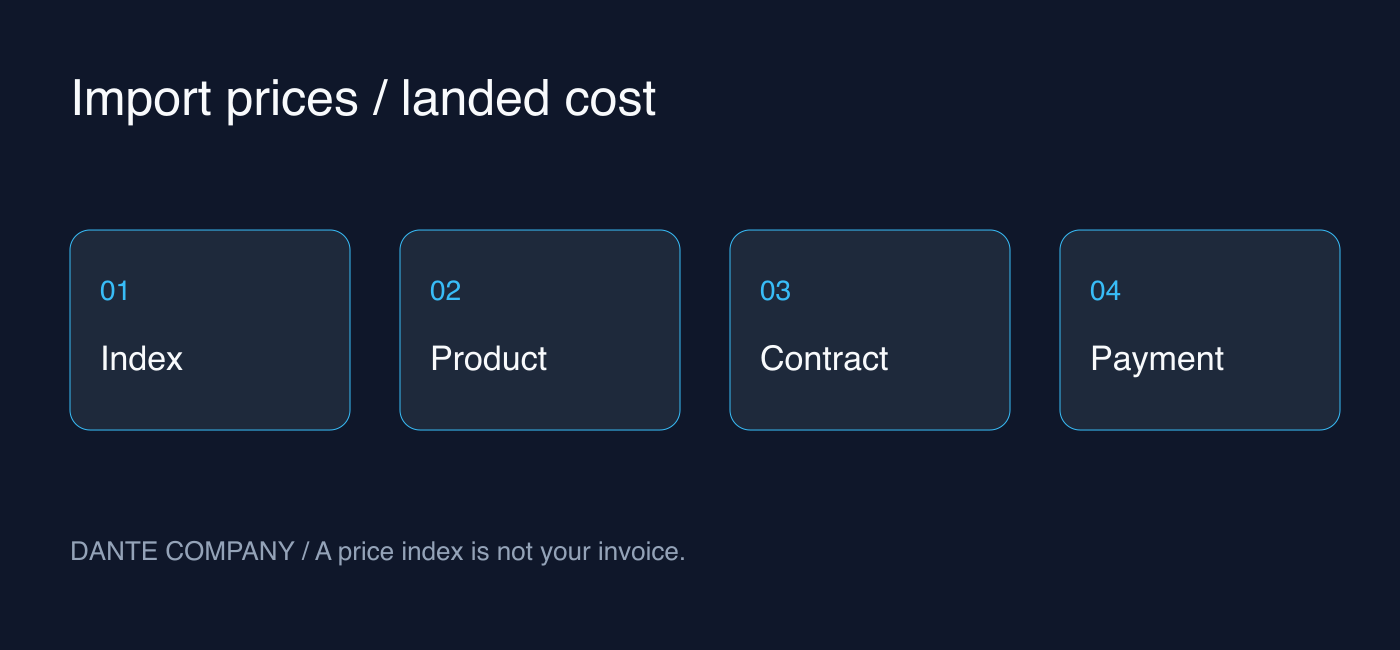
Practically, it is better to note down your purchased items, supplier quotes, contract currencies, and expected payment dates alongside the statistics. Also confirm through contracts and actual documentation who is billed for tariffs, freight, and insurance costs. The procedure below is an operational interpretation based on this statistical scope, not legal tax rate guidance for specific items.
A Cost Review Possible Even Without Attaching Numbers
Even if you order the same product at the same foreign currency price, local currency payments can vary if exchange rates at the time of settlement differ. If shipping costs are separate, total expenditures shift even if the supplier's unit price remains constant. Simply multiplying the index's monthly change across all of a company's costs misses these nuances.
In a simple cost sheet, record product costs, actually applied tariffs and customs clearance expenses, and shipping/insurance fees on separate rows. Do not double-count costs already included in quotes. Keeping notes on the exchange rate conversion benchmark and payment dates will prevent mixing up quote changes with currency fluctuation effects.
When Inventory Exists, Timing of Recognition Differs
A new quote reviewed today does not immediately alter this month's entire cost of goods sold. When inventory is on hand and newly ordered volume arrives later, cash expenditures and the cost of goods sold can occur at different times.
Small teams should first note order dates, scheduled receiving dates, and payment dates, and determine how long existing inventory can sustain sales. Between interpreting emerging price pressures and deciding whether to revise this week's price list, this operational context is essential. Actual inventory accounting treatment must be verified separately in accordance with the standards used by your company.
Order of Reading on Release Day
First, verify which reference month the release covers. Next, look at import and export trends separately alongside categories relevant to your business, and avoid reading month-over-month and year-over-year figures as if they were the same. Then compare these against recent supplier quotes to see if they move in the same direction.
If the direction of the index and your quotes diverge, examine product composition, timing, and currencies before concluding that one is wrong. Macroeconomic statistics have a broad scope of observation, whereas a quote reflects specific transaction terms. They may simply be answering different questions.
Counterpoints When Reading Market Narratives
Interpretations often emerge that slowing import prices will alleviate consumer price pressures. While this hypothesis describes a plausible transmission channel, whether this release will actually yield such an outcome remains unknown. One must also consider that time lags can arise as goods pass through distribution margins, inventory, and contractual terms.
Conversely, it is difficult to assume that all cost increases can be immediately passed on to selling prices simply because input costs rise. Customer demand, competition, and contract renewal terms must be evaluated. This article makes no claim of having surveyed current market consensus or projections, presenting instead the limitations of two interpretations to examine after the release.
A One-Pager for Small Teams to Prepare
Before the release, select your single most critical purchasing item and gather its latest quote, previous quote, contract currency, and payment schedule. After the release, compare it against the relevant index and decide whether you need to request updated quotes. If cost fluctuations are confirmed, reorder volumes and the timing of price reviews can be discussed together.
The key is connecting the price trends indicated by statistics with the actual costs borne by your company, without equating the two. This article provides information for understanding economic indicators and does not constitute investment advice. It does not recommend trading specific assets or predicting exchange rate directions.