
Reading the US jobs report: more jobs is not the same as more employed people
A report can show rising payroll employment and a higher unemployment rate without an immediate contradiction. Reading different surveys and denominators as one measure can distort both market commentary and a small team’s operating assumptions.
As checked on the morning of October 2, 2026 KST, BLS schedules the September Employment Situation for October 2 at 08:30 ET, or 21:30 KST. This is a prerelease reading guide. It does not claim to have verified September results or the market response.
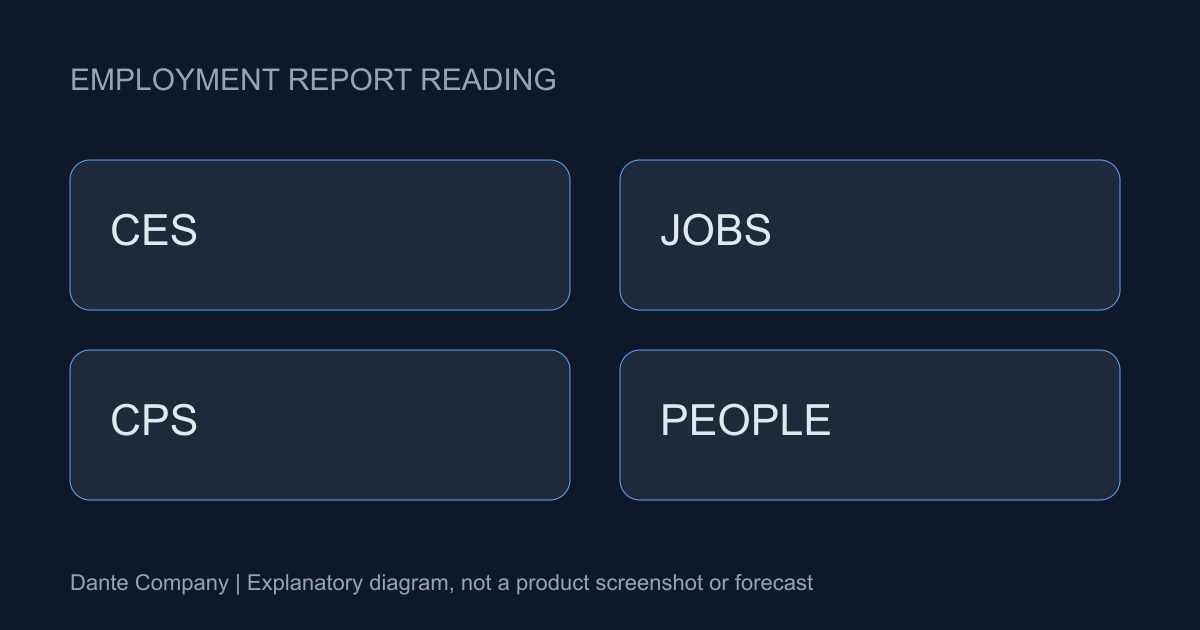
The payroll survey counts jobs
The CES establishment survey reports nonfarm employment, hours and earnings. A person with several nonfarm payroll jobs can be counted for each job. A change in payroll jobs is therefore not simply a count of newly employed individuals.
The CPS household survey measures people’s labor force status and supplies the unemployment rate. Multiple jobholders are counted once as employed people, and the scope includes groups such as the self-employed. Read the surveys together without equating their levels or monthly changes.
Write down the survey before the headline
For your own operating notes, record the indicator, survey, reference month, seasonal adjustment, release time and any revision to earlier values. Before copying a headline, ask whether it measures jobs or people.
For a hiring review, inspect employment, pay and hours in the relevant industry rather than relying on a national change alone. For purchasing power, consider employment status, labor force participation and your actual customer segment. These are proposed review steps, not a forecast.
Keep revisions and short-term noise visible
Employment statistics are estimates and can be revised. When a prior month changes, update the comparison baseline rather than isolating the latest monthly number. Sampling error and differences in coverage can contribute to divergence between the two surveys.
That does not mean an uncomfortable observation should be dismissed as an error. Record the monthly direction separately from a longer trend and compare it with your own revenue, applicant and churn data. This operational interpretation is not an official statistical conclusion.
Keep pricing and hiring as separate decisions
Before changing subscription prices or pausing recruitment after a headline, identify the assumption you intend to revise. Customer demand, labor costs and cash capacity are connected, but one indicator cannot settle all three decisions.
Start the next check with the BLS release and tables. After publication, verify actual results and revisions; do not substitute this guide’s prerelease check for new data. The diagram explains survey distinctions rather than forecasting figures or market moves. This article is informational and is not financial advice.