
Longer GitHub App tokens: audit the old 40-character assumption
If an integration worked yesterday and fails only with a newly issued GitHub token, inspect the path the string travels before expanding its permissions. A successful issuance request does not prove that a database field, secret store, or proxy preserved the credential for the final API call. A quiet truncation can turn an apparently healthy integration into an authentication failure.
On October 2, 2026, GitHub announced completion of its stateless GitHub App installation-token rollout. Newly minted tokens use the ghs_APPID_JWT format by default. They retain the ghs_ prefix but grow from 40 characters to roughly 520. This announcement concerns installation tokens; it is not a new universal format rule for every personal token or every credential bearing a GitHub label.
Separate the format change from the access model
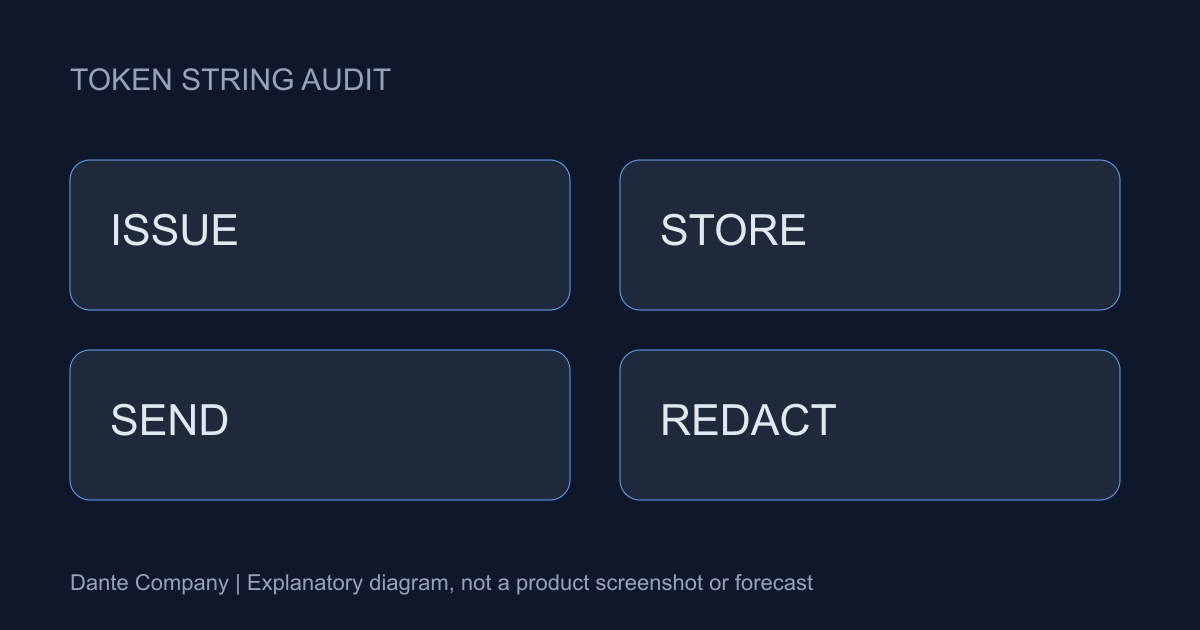
GitHub says permissions, repository scope, the one-hour expiration, and the issuance REST API endpoint remain unchanged. A response that widens permissions or rewrites expiration assumptions therefore does not address the stated format change. Keep token issuance and token consumption as separate investigation stages, and establish where the value first stops making it through intact.
The temporary X-GitHub-Stateless-S2S-Token header is scheduled for deprecation on November 30, 2026. GitHub recommends validating both token formats and removing that header before the date. Record the deadline with the integration owner so a temporary migration switch does not quietly become a permanent dependency in a forgotten deployment path.
Preserve an opaque string through storage and transport
Treat the token as an opaque string. Inspect exact-40-character validators, small database columns, secret-store limits, and middleware or gateways that reject or truncate long Authorization headers. The fact that the new token resembles a structured format is not a reason for an application to invent its own parsing-based authentication contract.
Start with a synthetic string rather than a live secret to test storage, retrieval, and forwarding. Record non-secret evidence such as input length, output length, and pass or fail; keep the token itself out of logs. Avoid replacing the old fixed length with an equally brittle fixed limit of about 520. Check each system's documented constraints and test the full route rather than declaring success after the first save.
Test redaction on failure paths as well
A credential reaching the API intact is only one part of the review. A masking expression written around the legacy length can leave part of a longer token visible. Use synthetic values to inspect accepted requests, rejected requests, retries, and exceptions. Error paths deserve attention because they often print the request context that a normal success path never exposes.
GitHub's security guidance covers least privilege, masking, registering transformed secrets, and reviewing logs. Put both the storage owner and the logging owner on your integration checklist. Our operational recommendation is to avoid treating one team's passing transport test as proof that the entire credential-handling route is safe. The redaction boundary can fail even when authentication works.
Validate a small integration and record the deadline
The practical developer question is whether existing systems preserve the string end to end, rather than how to decode the new format. We are not presenting that question as a measured community consensus. It follows from the failure boundaries named in the official notice and can be answered with reproducible tests in your own environment.
In a non-production integration, finish the synthetic-value checks, a real least-privilege call, and a log review before expanding the rollout. That order is this article's recommendation, not a deployment procedure mandated by GitHub for every organization. Keep the failing boundary, owner, and header-removal deadline in one review record so the next person can follow the evidence without seeing the credential.