
Before US real earnings: separate hourly purchasing power from weekly income
Hourly pay can rise while weekly income moves differently if paid hours fall. The BLS calendar schedules September real earnings for October 14 at 08:30 ET, alongside CPI, equivalent to 21:30 KST. Before those results arrive, it is more useful to define the columns you will read than to predict their direction or attach a market trade to an unpublished number.
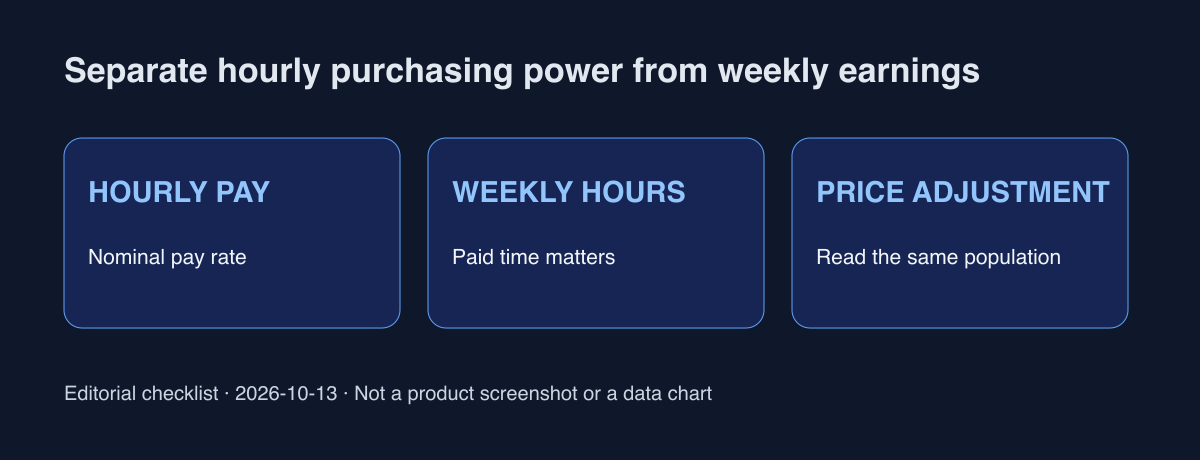
Hourly and weekly answer different questions
Hourly earnings describe pay per hour; weekly earnings also reflect hours. BLS calculates average weekly earnings as average hourly earnings multiplied by average weekly hours. This means an hourly headline alone cannot tell you what happened to a week’s earnings. Keep the hours column beside pay rather than treating a change in the hourly rate as a complete account of income.
Real means there is a price adjustment
Real earnings adjust nominal earnings with consumer price indexes to describe purchasing power. BLS uses CPI-U for the all-employees series and CPI-W for production and nonsupervisory employees. Check which population and deflator the table uses before combining figures. A comparison that quietly changes both may look precise while answering a different question from the one you intended.
The average is not your own pay change
The series summarizes private nonfarm jobs; it does not track one person’s contractual wage or a household’s after-tax income. The mixture of higher- and lower-paying industries can also move an average. A rise in average earnings therefore does not establish that every worker received the same raise. Use the published scope to keep a broad indicator separate from a personal payroll story.
After release, read three matching columns
Choose all employees or production and nonsupervisory employees, then compare nominal hourly pay, weekly hours and real weekly earnings over the same period. Separate monthly from annual changes. Our interpretation suggestion is to ask where the pay-rate change and the hours change meet; it is not a claim about what September’s figures will show or how markets must react.
A small team should budget from its own contracts and actual hours. US average real earnings can supply context for demand and purchasing power, but it is not a formula for a Korean team’s pay increase or for each customer’s spending. Keep your operating calculation independent, then use the release to revisit the assumptions you explicitly chose.
An improving average can coexist with a household feeling no improvement. Taxes, its spending mix and its individual hours are not fully represented by one series. The calendar and measurement definitions are official evidence; applying them to a team budget is interpretation. We have not presented an unverified community story as a confirmed statistic.
Official sources
BLS · Real earnings technical note
Informational economic commentary, not investment advice. Schedule checked October 13, 2026; September results are still pending.