
GitHub Actions lockfile preview: review the commit you pin
If a reviewed workflow later executes different code, what exactly did the team approve? GitHub announced its workflow dependency lockfile public preview on October 14. It connects the references people read in YAML with the commits that will run. For a small team, the important decision is who reviews those commits and who owns the next dependency update, rather than simply whether a new file exists.
Check availability and record the environment
The corrected announcement includes GitHub Enterprise Cloud, Enterprise Cloud with data residency, Team and Free. This is a public preview. The official gh-actions-lock repository says GHES is unsupported and warns that pre-1.0 formats and behavior may change. Record the documentation date and extension version in your adoption notes so later failures can be investigated against the environment that was actually reviewed.
Separate a readable tag from an approved commit
The extension generates .github/workflows/actions.lock. For onboarded workflows, it records commits for actions, transitive dependencies and reusable workflow dependencies. That reduces the risk of a moved reference silently changing execution after review. It does not establish that the pinned code is safe. Someone must still examine the dependency and decide whether its behavior is appropriate for the workflow's authority.
Start with a reviewable adoption change
The following is an operational proposal. Choose one test workflow without deployment authority or production secrets. Inventory its uses references, dependency owners and purpose. Review the generated workflow and lockfile changes in one pull request, then connect that review to the resulting run. Do not treat a generated file as sufficient evidence to require locking across every production workflow immediately.
Give updates an owner
The official README documents gh actions-lock --verify as a check that does not write files. Its --verify-local mode is an offline structural check and is not a substitute for trust verification. Keep the CI result separate from dependency code review. Assign an update reviewer and document when a failed check should stop execution and how to restore a previously reviewed state. No extension was installed or reader repository changed for this article.
According to the announcement, Dependabot action version updates for onboarded workflows regenerate the corresponding lockfile entry in the same pull request. Generated changes still need review. Our suggestion is to inspect the human-readable reference and resolved commit together, then check whether new code changes required permissions or external communication. Automation can keep files aligned; it cannot make the team's acceptance decision.
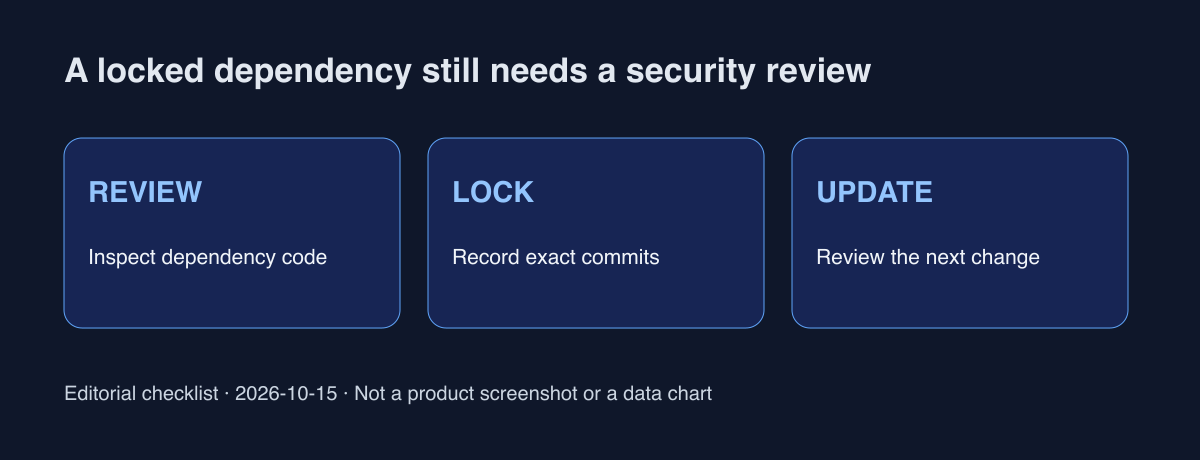
The practical confusion is treating reproducibility as a security verdict. The announcement credits community feedback, but it does not establish an incident reduction rate or universal compatibility. Check the current README before adoption because preview details can change. A useful rollout record names three responsibilities: dependency review, locked execution and subsequent updates, with an accountable owner for each.
Official sources
Official announcement, repository and documentation checked October 15, 2026. Product behavior is separated from our operational proposals.