
Expanding GitHub Security Configuration Enforcement: Operational Procedures to Prepare When Organization Owners Cannot Make Changes
When an organization owner tries to modify security settings and cannot, it is easy to assume a permissions error. However, if the configuration is enforced at the enterprise level, this may be the intended behavior. As central policies are enforced more strictly, not only do the configuration values change, but so does the path for change requests.
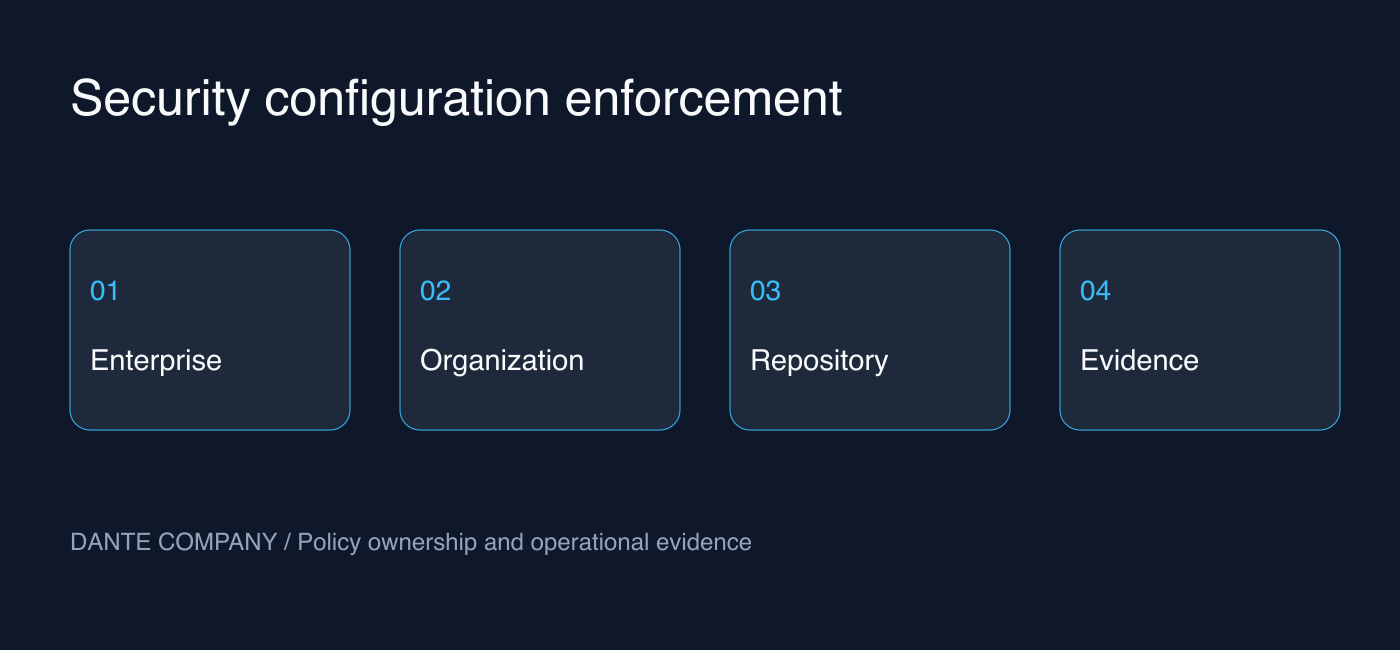
GitHub announced on September 15, 2026, that it expanded the enforcement scope of Advanced Security configurations. This article is not a blanket recommendation to apply the new policy everywhere, but a guide for teams evaluating adoption on how to prepare permission boundaries and operational evidence.
The Confirmed Change Is the Scope of Modification Permissions
According to the official announcement, enterprise owners can enforce enterprise-level security configurations across organizations and prevent organization owners and repository administrators from overriding those settings. Previously, enforcement only restricted changes by repository owners.
The interface presents three options: do not enforce, enforce for repository owners, and enforce for both repository and organization owners. Therefore, you should not assume that organization owners face the same restrictions simply because an existing configuration is labeled as enforced. You must verify the selected scope directly.
Separately Verifying Unified Settings and Scan Success
From this point onward, these are operational recommendations based on the official update. Keep separate records proving that settings were locked centrally versus evidence that scans actually executed in repositories. Simply seeing a consistent settings page is not enough to conclude that all code paths were analyzed.
In a concise checklist, record the target repositories, the configuration to apply, the person responsible for changes, and where to verify scan results. For features requiring scan execution, check recent runs and outcomes; if no results are found, investigate policy application and execution issues separately. The goal is to avoid evaluating the utility of a new setting solely by the count of alerts.
Identifying Operational Leads Before Piloting
Start by documenting what the central security team and repository owners can each modify. If tasks previously handled by organization owners must now be requested from enterprise owners, establish designated recipients and turnaround times for urgent requests. This preparation ensures that shifting permissions upward does not create an unmonitored queue.
For example, consider a scenario where scan configurations need adjusting for a repository nearing deployment. Instead of sending just an error screenshot, the requester explains the repository, affected workflows, required adjustments, and deadlines. The approver evaluates the necessity of the exception and the rollback timeline. This procedure is not an automated exception feature provided natively by GitHub, but an operational process your team establishes.
Establishing Success Criteria in a Representative Repository
A pilot scope should ideally use a repository that represents actual operational architecture while keeping the blast radius manageable. Prior to rollout, document current configurations and access levels for stakeholders; after rollout, confirm respectively whether intended personnel can or cannot alter settings. If permissions deviate from expectations, pause the broader rollout and identify the root cause.
Interpret scan results in the same pre- and post-change context. Do not immediately assume a new vulnerability was introduced just because a new alert appears; verify whether the scan scope or execution conditions changed. Conversely, if alerts disappear, obtain evidence to distinguish whether the scan was skipped or the issue was genuinely resolved.
Pairing Exceptions: Requests and Expirations
The more strictly policies are enforced, the more essential it becomes to foster a culture that does not conceal exception requests. An exception request should detail the rationale, scope, duration, and reviewer, while specifying what to verify upon conclusion. Once the underlying issue is resolved, document proof of returning to the baseline policy.
Loosening configurations across the entire organization merely due to operational friction may be an overreaction. On the other hand, refusing to review any exceptions may incentivize teams to seek workarounds. Establishing a review process for well-defined requests with clear scopes and timeframes provides the right balance.
Questions for Community Channels and Interpretive Limits
The questions to verify in team channels after adoption are straightforward: Can practitioners who cannot change settings recognize that it is due to policy, whom should they contact, and when will they follow up after a request? This article does not present survey data measuring incident frequency or universal sentiment across the broader community.
Nor must every enterprise immediately adopt the strictest option. When operational approaches and approval turnaround capabilities vary by organization, the burden imposed by the same setting differs. Check current official documentation for applicable features and account requirements, and avoid promising cost savings or incident reduction metrics without empirical evidence.
Deliverables to Establish Today
Select a critical repository and outline on a single page the enforcement scope, configuration owners, scan verification locations, and exception contacts. Next, determine the states to verify before and after the pilot, and assign a reviewer. The objective is to simultaneously strengthen central policy enforcement and clarify resolution paths on the ground.
The key takeaway for practitioners from this change is that enterprise configurations can now prevent organization owners from overriding them. Therefore, before treating a setting modification failure solely as a permissions error, identify the source of the policy and ensure scan results and exception requests remain fully traceable.