
Before US state employment data: do not copy a national rate into a local hiring budget
A national unemployment release does not establish conditions in the state where your customers or prospective hires live. The BLS October 2026 calendar schedules September State Employment and Unemployment for October 20 at 10:00 a.m. Eastern Time, or 11:00 p.m. KST that day. Written on the morning of October 19 KST, this is a pre-release reading guide. It does not forecast the September state results or imply they have already been published. If reading a scheduled copy after the release, check the official results first.
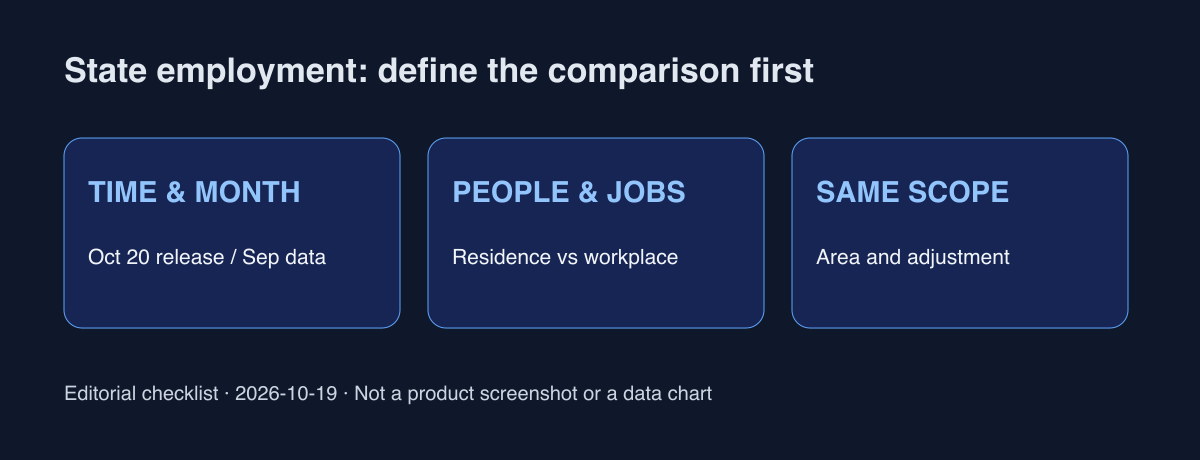
Record publication time separately from reference month
The same calendar places September Metropolitan Area Employment and Unemployment on October 28 at 10:00 a.m. Eastern Time. A state release therefore does not mean metropolitan results are available at the same time. Record the calendar-check time, publication time, reference month, and geographic coverage separately. Recheck the official schedule on release day because schedules can change. Leave an unavailable observation blank rather than filling it with a national figure or the previous month's value.
Start with the denominator of unemployment
The BLS LAUS explanation defines unemployment as unemployed people relative to the civilian labor force. An employed person is counted once even when holding multiple jobs. Before interpreting a lower rate as stronger local demand, inspect labor-force, employment, and unemployment levels together. Fewer unemployed people and a changing labor-force denominator answer different questions. These are reading principles, not assumptions about which movement will appear in the forthcoming release. A rate alone cannot tell the whole story a hiring or demand plan needs.
Distinguish where people live from where jobs are located
People measured in household and labor-force statistics are not the same unit as jobs counted through establishments. A team evaluating hiring should identify the table before interpreting its numbers. Where commuting matters, residents' employment status is not a direct measure of recruitment difficulty at a particular workplace. Multiple jobholding also prevents subtracting the two counts to manufacture vacancies. Your own hiring feasibility depends on skills, working arrangements, and applicant responses in addition to the regional backdrop.
Build a comparable panel before ranking places
The following is an operational proposal rather than a statistical-agency forecast. Choose states connected to actual customers or hiring plans before inspecting results. Compare the same reference month, measure, and seasonal-adjustment status. Do not rank a state rate against an unadjusted city observation, or mix headcount changes in a large state with rate changes in a small one. Attach units, adjustment status, release vintage, and source links to the budget memo so later revisions remain traceable.
This research does not quantify regional sentiment or community reactions. A national indicator may be sufficient for a nationally diversified business. State data can sharpen assumptions when revenue or recruiting is geographically concentrated, but cannot by itself explain a neighborhood or a specific occupation. More geographic detail does not automatically create a more accurate decision. Keep the granularity aligned with the question and acknowledge what the chosen area still leaves unresolved.
Before release, agree on the reading sequence while the result cells remain empty: target states, residence-based labor measures, establishment jobs, adjustment labels, and the next check. Afterward, read the official significance and revision notes, then compare with your own applicants, orders, and customers. Do not automatically change hiring or cash budgets after one monthly observation. Write down in advance which additional evidence would actually change the operating assumption.
Official sources
BLS · October 2026 release calendar
BLS · LAUS questions and definitions
This economic commentary is informational, not investment advice. Check the released results and compare like areas and measures.