
US industrial output rises 0.7%: separate factories from utilities
A rising industrial-production headline can sound like a broad recovery in factory orders. Yet electricity and gas utilities need not reflect the same demand as manufacturers. The Federal Reserve’s September G.17, released October 16, 2026, is more useful when the aggregate direction is separated from the industry closest to your business. This article distinguishes confirmed statistics from an operational interpretation. It does not turn a national release into a forecast for a particular supplier, customer, or investment.
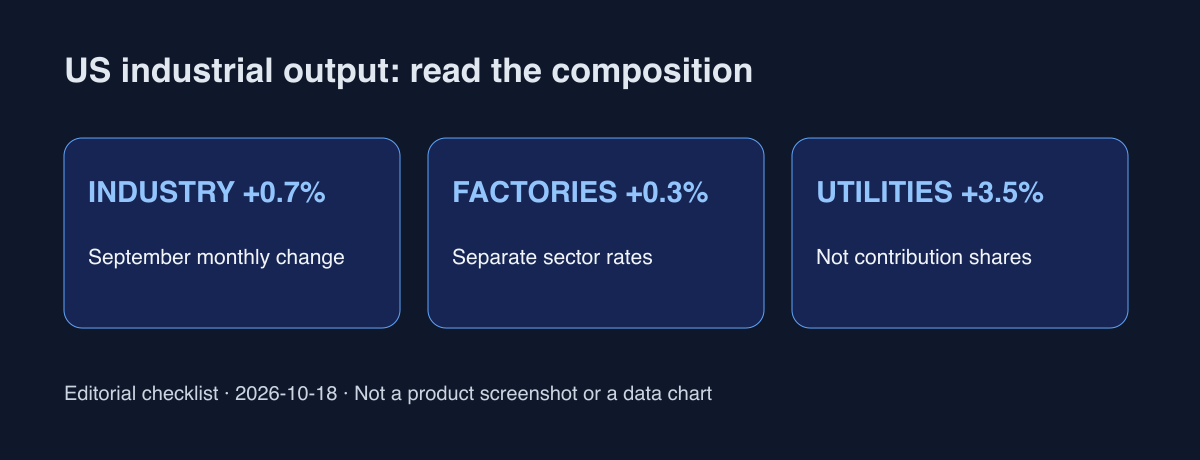
Confirmed results: the aggregate and industries moved at different speeds
Seasonally adjusted industrial production increased 0.7% in September from August. Manufacturing rose 0.3%, mining 0.2%, and utilities 3.5%. Total capacity utilization was 76.9%, or 2.5 percentage points below its long-run average. September observations are preliminary. Industry growth rates are not contributions to the aggregate: adding them, or treating the largest rate as proof that it explains most of the total gain, is not valid. These observations also do not measure any individual company’s orders or profits.
Separate output, revenue, and utilization
G.17 measures real industrial output across manufacturing, mining, and electric and gas utilities. It is not a sales-revenue series or a growth rate for the entire service economy. Utilization expresses the seasonally adjusted output index as a percentage of its related capacity index. Since capacity can change alongside output, record the utilization level separately from output growth. A gap against a historical average is a comparison, not a promise that the next month must close that gap. A low aggregate reading can coexist with constrained capacity in the specific activity your team needs.
Change the verification sequence before changing a forecast
The following is an operational proposal, not an agency prediction. A team ordering hardware or physical goods can first identify the industry nearest its supplier, then place the actual quoted price, minimum order quantity, and delivery lead time beside it. Raising preorders merely because the total index increased can create inventory disconnected from customer demand. Conversely, a weak macro observation does not invalidate confirmed customer orders. Use the release to formulate questions; connect purchasing and contract decisions to evidence from your own business rather than substituting a national headline for that evidence.
The counterargument when reading utilization
Spare aggregate capacity does not establish that a supplier can immediately lower prices or shorten delivery. The equipment, staff, or components needed for a particular product may remain constrained. A large utilities move also does not show that factory orders grew at the same pace. But emphasizing composition should not erase the improvement in overall industrial output either. Keep the aggregate, the relevant industry, and contradictory evidence in view. The aim is a more specific purchasing question, not a predetermined optimistic or pessimistic conclusion.
Public market discussion raises questions about what stronger production and spare capacity mean for earnings. Such posts are used only as signals of reader interest, not as evidence for the reported numbers. This article forecasts neither share prices, exchange rates, nor a policy-rate path. Moving from physical output to revenue or investment return requires additional evidence about product mix, selling prices, inventories, and costs. A directionally positive macro release can therefore be useful without being a sufficient reason for a trade or a larger purchase commitment.
At the next review, record release date, reference month, seasonal-adjustment status, preliminary or revised status, the aggregate, the relevant industry, and supplier-quote changes together. Preserve earlier releases instead of overwriting them when a new observation arrives. Write one sentence about the assumption that should change and one about the assumption that should remain. This creates an auditable decision record and limits headline-driven overreaction. This content is for information only and is not financial advice.
Official sources
Federal Reserve · September G.17
At your next purchasing review, keep the aggregate index and the supplier’s actual quote in separate fields.