
Xcode 27 runners reach GA: validate builds and Apple Silicon separately
A workflow can turn green after a runner change while its release candidate still fails at the native-library boundary. GitHub announced general availability of its Xcode 27 runner image on October 15, 2026. For a small Apple app team, the useful decision is more specific than whether to adopt the new image. Establish which tools actually ran, whether native build dependencies execute on the runner, and whether the resulting candidate can be installed. Those are separate claims, each requiring evidence.
Read the availability boundary first
The announcement says the image runs on macOS 27 and includes the Xcode 27 toolchain and Apple SDKs. Select xcode-27 or xcode-27-xlarge in runs-on; workflows already using those labels need no change. Availability is limited to Apple Silicon arm64 runners, not Intel runners. Each image targets a major Xcode version rather than a particular operating-system version. General availability is a statement about the service offering, not certification of every binary, package installer, or signing path in your repository.
Evidence one: the tools that were actually selected
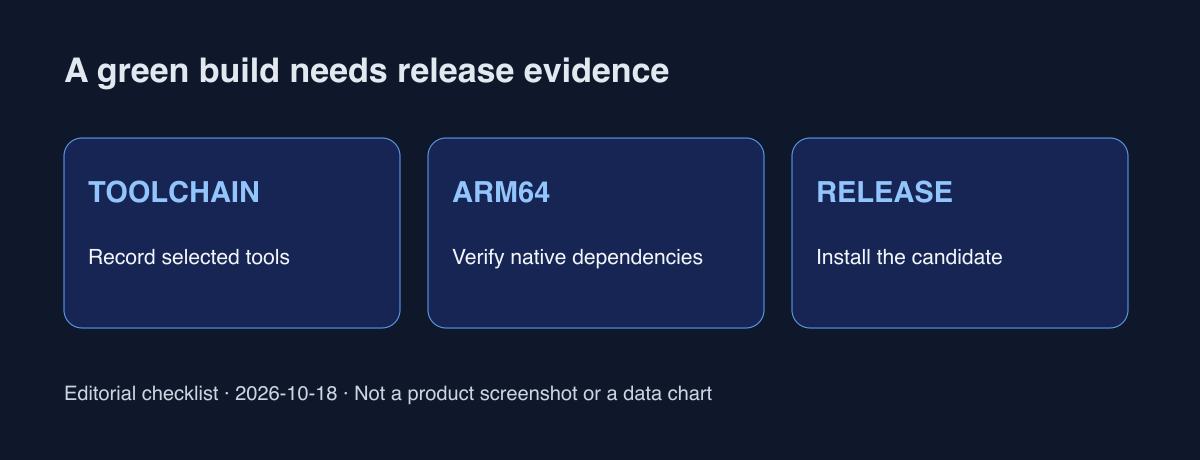
The following is an operational proposal, not a newly announced GitHub feature. Create a comparison run at the same commit before replacing the release workflow. Record the runner label, uname -m, xcodebuild -version, the selected developer directory, and SDK inventory. Exclude secrets and signing assets from these logs. A label alone cannot reveal that a command selected a different installed toolchain. Attach the commit and run identifier to failures so another engineer can reproduce the starting conditions instead of guessing which image or branch was involved.
Evidence two: native dependencies and their execution paths
Ask two independent questions. Can the code generators, package-install scripts, and prebuilt utilities that execute on the runner operate on arm64? Does the application artifact contain binaries for its intended targets? Passing one check does not answer the other. Review cache boundaries for architecture and toolchain changes, and retain an uncached comparison run. Repeatedly deleting caches until a build passes destroys useful evidence about the failing condition. Likewise, a simulator test is useful but cannot replace checking the archive intended for a physical device.
Evidence three: a release candidate and a way back
Keep compilation, tests, archive creation, and export as separate recorded outcomes. If the comparison run needs signing, use the existing approved secret-management path and never add credentials to diagnostics. Make the switch after an internal distribution candidate has passed installation and launch checks. Preserve the prior workflow and a reproducible commit as rollback references. No build-time improvement or cost saving is promised here: assess those questions with your own measurements under the same commit, cache conditions, and test scope.
This research does not provide quantified community sentiment. The checklist instead addresses questions that can become conflated during migration. A project needing the new toolchain does not imply that every repository should switch simultaneously. Separate applications with extensive native dependencies from simpler projects, and decide who owns each failure and where its evidence will live. Deferring adoption also has a cost; a bounded trial with agreed acceptance criteria is more useful than an indefinite freeze or an unmeasured fleet-wide migration.
For the next engineering cycle, choose one representative app and one comparison commit. Connect the old and xcode-27 runs to tool inventory, test outcomes, and exported candidates. Consult runner-images for installed software and report problems with reproducible conditions. The completion criterion should be an installable candidate and a documented recovery path at the same commit, rather than a green check whose meaning changes between jobs. That turns a runner-label edit into a migration the team can review and repeat.
Official sources
GitHub Changelog · Xcode 27 GA
Start by connecting these three pieces of evidence for one Apple application workflow.